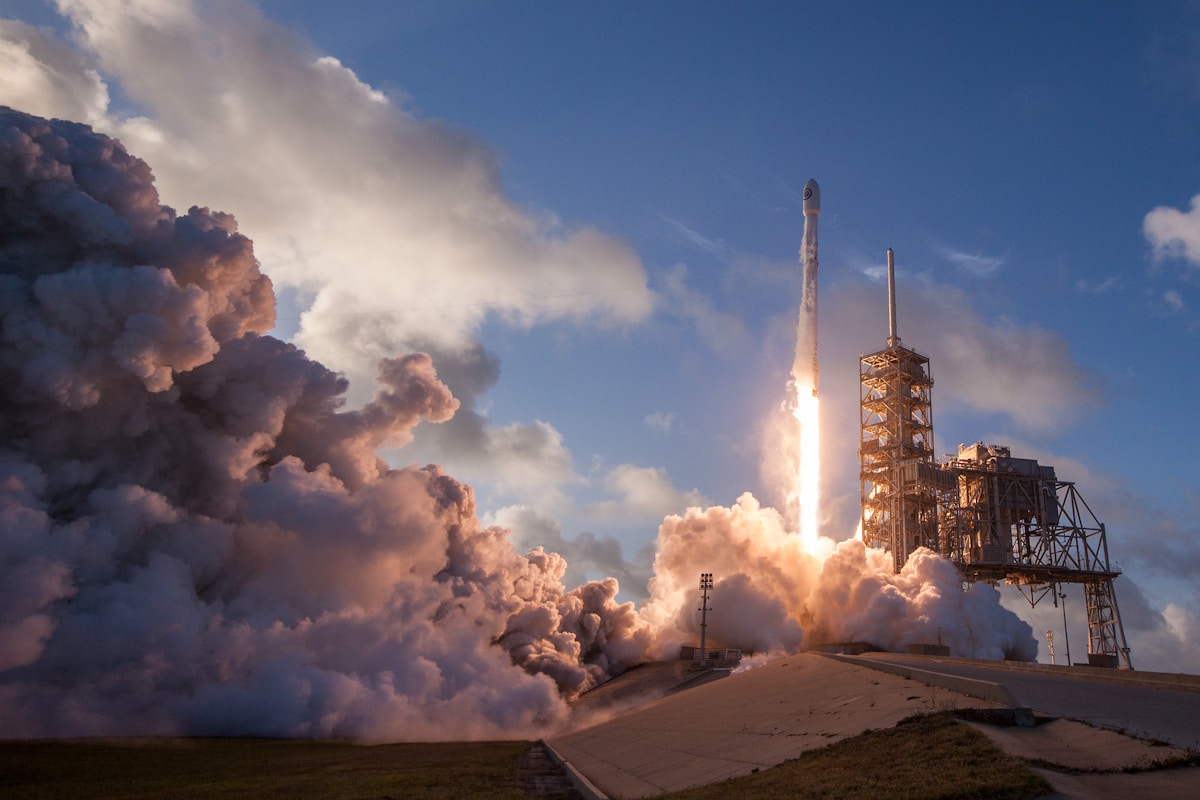
Two synthetic-aperture radar (SAR) satellites built by Finland’s ICEYE for the Portuguese Air Force reached orbit on Tuesday 20 October, the Air Force announced. The spacecraft, designated CA-03 and CA-04 in the Air Force’s statement, flew on SpaceX’s Bandwagon-5 rideshare mission aboard a Falcon 9 from Space Launch Complex 40 at Cape Canaveral, Florida. Both have established communications, and the routine commissioning work needed before they enter service is under way. The launch had initially been planned for 19 October, ECO reported.
| Satellites | Two SAR satellites, CA-03 and CA-04 (Atlantic Constellation) |
|---|---|
| Manufacturer | ICEYE (Espoo, Finland); launch integration by Exolaunch |
| Buyer / operator | Bought by CTI Aeroespacial under the PRR-funded New Space agenda; operated by the Portuguese Air Force |
| Contract | Confirmed by ICEYE on 17 June 2026 |
| Launch | 20 October 2026, SpaceX Bandwagon-5, Falcon 9, SLC-40 Cape Canaveral (one-day delay) |
| Earlier launch | CA-01, 30 March 2026 |
| Next step | Satellite assembly at the Space Hub in Alverca, on Air Force premises |
Sources: Portuguese Air Force (20 October 2026); ECO (13 and 20 October 2026); AeroTime (20 October 2026); ICEYE (17 June 2026). ECO’s report refers to the pair as CA-02 and CA-03; this article follows the Air Force’s designations.
From contract to orbit in four months
The launch closes a procurement that NorthSouth HQ covered in June, when ICEYE confirmed that CTI Aeroespacial, the vehicle set up by the Air Force and the engineering centre CEiiA, had signed for two additional SAR satellites. According to the Air Force, the satellites were acquired by CTI Aeroespacial under the New Space agenda funded by Portugal’s Recovery and Resilience Plan (PRR), and they continue the path that began with the launch of CA-01 on 30 March this year. The satellites carry X-band radar, which images the surface regardless of cloud cover or daylight. The Air Force says that matters most for surveillance of Portugal’s land and maritime areas, for security support and for emergency management.
Exolaunch, the German launch-services company, integrated the satellites on the Falcon 9. ICEYE itself confirmed on 20 October that four of its satellites had separated from the rocket on Bandwagon-5, AeroTime reported; the Air Force statement accounts for two of them. Defence minister Nuno Melo had said on 13 October that two Atlantic Constellation satellites were already in orbit, according to ECO, which puts the count at four after this launch.
Why the orbit matters
SpaceX’s Bandwagon missions serve mid-inclination orbits, unlike its Transporter rideshares, which go to sun-synchronous orbit. When ICEYE flew two satellites on Bandwagon-2 in December 2024, it said mid-inclination orbits gave more than twice the collection opportunities of a polar orbit between 45 degrees north and 45 degrees south, AeroTime noted. Mainland Portugal, Madeira and the Azores all sit inside that band. ICEYE has not published the orbital parameters of the satellites launched this week.
The Finnish link, now on the ground in Lisbon
Both statements carried a quotation from Rui Costa, chief executive of ICEYE Portugal, the subsidiary the Finnish company set up in July with a Lisbon centre of excellence. “Portugal’s sovereign SAR capability for the Atlantic takes an important step forward with the addition of these two satellites to its constellation. From Lisbon, we will continue to develop this capability in collaboration with CTI Aeroespacial and the Portuguese Air Force,” he said (NorthSouth HQ translation, as for all Portuguese quotations here). General Sérgio da Costa Pereira, the Air Force chief of staff, said the two satellites strengthen “Portugal’s sovereign capacity to observe, understand and protect what is its own”, adding that “more capacity in space means greater freedom of action on Earth”.
Alverca is where the next ones are meant to be built
The bigger commercial story for the corridor is what comes next. ECO reports that ICEYE’s Portuguese operation is linked to the future satellite factory at Alverca, the Space Hub being set up on Air Force premises, and that the satellites Portugal buys under the EU’s SAFE defence-loan programme will be built there. On 13 October Nuno Melo said the constellation’s satellites would be “produced from this year in Portugal and in Alverca, in Air Force facilities”, and cited the factory as an example of defence investment backed by Portugal’s SAFE envelope. He referred to 24 satellites in the Atlantic Constellation. ECO adds that the satellites and the hub draw on €15 million of PRR funding, and that the Air Force has received a further €15 million through the PRR for launch capability on Santa Maria in the Azores.
Neither the Air Force nor ICEYE has said how many satellites Alverca will assemble, on what timetable, or what share of the work will be done by Portuguese staff and suppliers. Those details will determine whether the Finnish relationship becomes a domestic manufacturing base or remains, mainly, an import of finished spacecraft.
What to watch
Three things are worth following: confirmation that CA-03 and CA-04 have completed commissioning and are delivering imagery; the first public detail on SAFE-funded satellite orders and the start of assembly in Alverca; and progress on Portugal’s planned entry into NATO’s space-surveillance programme, which NorthSouth HQ examined in July and to which Denmark, Finland, Norway and Sweden already contribute. ICEYE was also among the Finnish companies cited when Portugal’s foreign minister visited Helsinki on 5 October. Other Finnish companies active in Portugal are listed in the NorthSouth HQ directory of Finnish companies in Portugal.